

What Is a Pool Clarifier?
A pool clarifier is a chemical agent designed to remove microscopic particles that make water appear cloudy.
These particles—such as silt, algae spores, oils, and minerals—are too small for a standard pool filter to trap.
Clarifiers work by gathering these tiny contaminants into larger clumps that the filter can then capture and remove.
Clarifiers are not a cure-all. They should be used only after ruling out other causes of cloudiness, such as pH imbalance, algae blooms, or improper sanitizer levels. When those issues are fixed but water remains hazy, a clarifier is the right next step.
How Does a Pool Clarifier Work?
The mechanism is straightforward. Most clarifiers contain positively charged molecules. When added to pool water, these molecules attract negatively charged particles suspended in the water. The particles stick together, forming clumps large enough to be caught by the filter.
This process is called coagulation. Unlike flocculants, clarifiers create clumps that remain floating in the water column rather than sinking to the bottom. Over time—usually one to three days—the filter continuously removes these clumps, and the water becomes clear. No manual vacuuming is required.
Pool Clarifier vs. Flocculant
Both clarifiers and flocculants coagulate particles, but they are designed for different situations. Understanding the difference helps you choose the right product.
FactorClarifierFlocculantCloudiness levelMild to moderateModerate to severeAction time2–3 daysAs fast as 7 hoursDebris removalThrough filterVacuuming from pool floorBest forFilters (sand, cartridge, DE)All filters, especially after stormsEffort requiredLow – let filter runHigh – must vacuum
Clarifiers are ideal when you want a low-maintenance solution and can wait a few days. Flocculants work faster but require manual vacuuming.
Use a clarifier for light cloudiness where the pool floor is still visible; use a flocculant for dense cloudiness where the bottom cannot be seen.
When to Use a Pool Clarifier
- At pool opening – after winter, water often contains fine debris.
- After an algae bloom – once the algae is killed, dead particles remain.
- After heavy use – a pool party can introduce oils and debris.
- As a weekly maintenance boost – a small dose keeps water sparkling.
Clarifiers are not effective against living algae or severe chemical imbalances. Always treat those problems first.
Step-by-Step Guide to Using Pool Clarifier
1. Test and Balance Water Chemistry
Use a test kit to check pH, total alkalinity, and sanitizer levels. Adjust pH to 7.4–7.6 and alkalinity to 80–120 ppm. Clarifiers only work if the cloudiness is caused by fine particles, not by chemical imbalance.
2. Shock the Pool
If you have not already done so, perform a shock treatment to kill any bacteria or algae. Wait at least 24 hours after shocking before adding clarifier. Shocking can also help break down organic particles.
3. Skim, Brush, and Vacuum
Remove large debris with a skimmer. Brush walls and floor to loosen stuck particles. Vacuum the pool to eliminate any settled dirt. This ensures the clarifier can focus on the fine suspended particles.
4. Keep the Filter Running
Turn on the pump and filter. Run them continuously while the clarifier is working. Good circulation helps distribute the clarifier and move clumped particles toward the filter.
5. Calculate and Add Clarifier
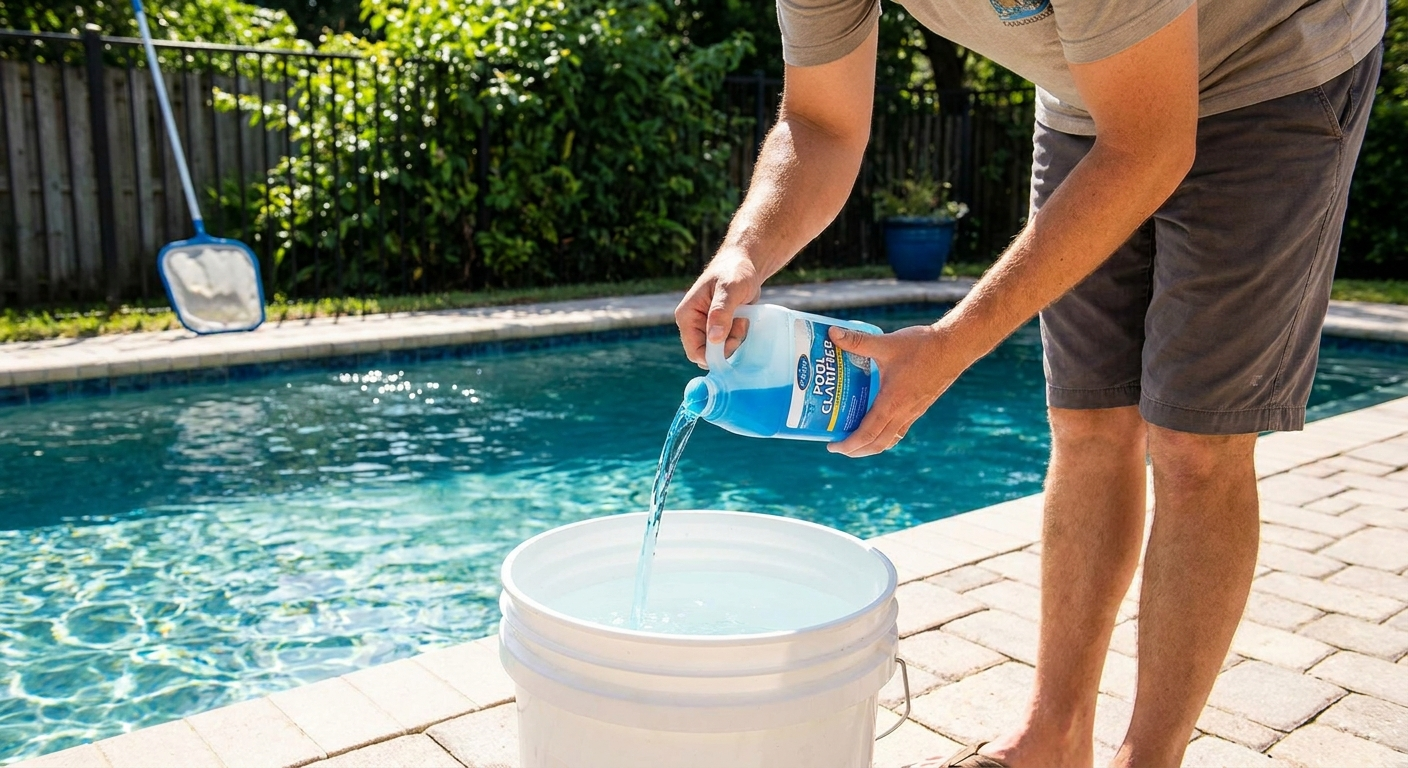
Determine your pool’s volume in gallons. Read the product label for the correct dosage. Pour the clarifier evenly around the pool edge, or dilute it in a bucket of water first. For best dispersion, add it near a return jet.
6. Monitor and Clean the Filter
Over the next 24–72 hours, check the filter pressure gauge. If pressure rises, the filter is catching the clumps. Backwash a sand filter or clean a cartridge filter as needed. Do not turn off the pump during this period.
7. Retest and Enjoy
Once the water is clear, test your water chemistry again. Some clarifiers can slightly alter pH or alkalinity. Adjust if necessary. Then you can swim with confidence.
Maintenance Tips for Clear Pool Water
- Run your filter at least 8–12 hours daily, especially during hot weather.
- Test water chemistry weekly and adjust promptly.
- Clean or backwash the filter regularly to maintain efficiency.
- Use a skimmer to remove leaves and debris before they break down.
- Consider adding a small dose of clarifier weekly as a preventative measure. For detailed product recommendations and usage advice, consult a reliable pool clarifier guide.
Choosing the Right Clarifier
Two main types are available: polymer-based and natural. Polymer clarifiers are the most common and work well for most pools. Natural clarifiers use plant-derived agents and are gentler on the environment. Both are effective, so choose based on your preference.
Avoid using clarifiers with diatomaceous earth (DE) filters unless the label specifically allows it. Sand and cartridge filters are generally compatible.
Final Thoughts
A pool clarifier is a valuable tool for any pool owner dealing with mild, persistent cloudiness.
It saves time and effort compared to more aggressive treatments.
By following the correct steps—balancing, shocking, and filtering—you can restore clarity quickly.
Regular use helps maintain that inviting sparkle all season long.
