

The fastest way to get more enquiries from Google Ads is to tighten up your targeting, fix your landing pages, and track what actually converts. Most law firms in Australia skip at least one of these steps, and that’s where the budget leaks start.
At www.mattersolutions.com.au, we’ve managed legal PPC campaigns for law firms for years, so we’ve seen firsthand what turns ad spend into signed clients and what just burns through a monthly budget.
This guide walks you through campaign setup, landing page fixes, ad spend control, and tracking. So, every dollar your firm puts into Google Ads has a clear purpose behind it.
Why Google Ads Work So Well for Lawyers in Australia
Google Ads puts your firm in front of people actively searching for legal help, right when they need it most. Unlike traditional law firm marketing, you don’t wait months to see results because paid ads show up at the top of search results straight away.

That high intent is what sets legal PPC apart. Because someone searching for “family lawyer Brisbane” or “personal injury solicitor Sydney” actually needs legal assistance soon.
It’s also why legal services carry the highest average cost per click across all industries. We’ve even seen this pattern play out across our law firm accounts since 2012, with returns growing stronger the longer a campaign runs.
Common Ways Law Firms Waste Money on Google Ads
Ever wondered how much of your Google Ads budget goes to clicks that will never become a phone call? Well, if your firm runs ads without a clear strategy, the spending will pile up with nothing to show for it.
These three mistakes show up in legal marketing campaigns all the time.
- No Negative Keywords: Without negative keywords, your ads will show for searches like “free legal advice” or “DIY legal help”. These searches pull in irrelevant traffic from people who will never hire a lawyer.
- Broad Match Overuse: Broad match keyword phrases trigger your ads for loosely related searches that have nothing to do with your services. Frankly, most firms don’t catch this until half the monthly budget is already gone.
- No Conversion Tracking: If your firm skips conversion tracking, you will have no way to know which campaigns bring in real client inquiries and which ones drain your ad spend. Many law firms run Google Ads for months without this data, so every budget decision becomes a guess.
Each of these mistakes hides a different problem, but fixing even one can free up budget for clicks that bring in actual clients.
Now, let’s look at what a properly built campaign looks like.
Setting Up Google Ads Campaigns That Attract Potential Clients
A well-structured campaign does the heavy lifting by showing the right ad to the right person at the right time. When your Google Ads account is built around each specific legal service, your ads become more relevant, and your reach to potential clients improves.
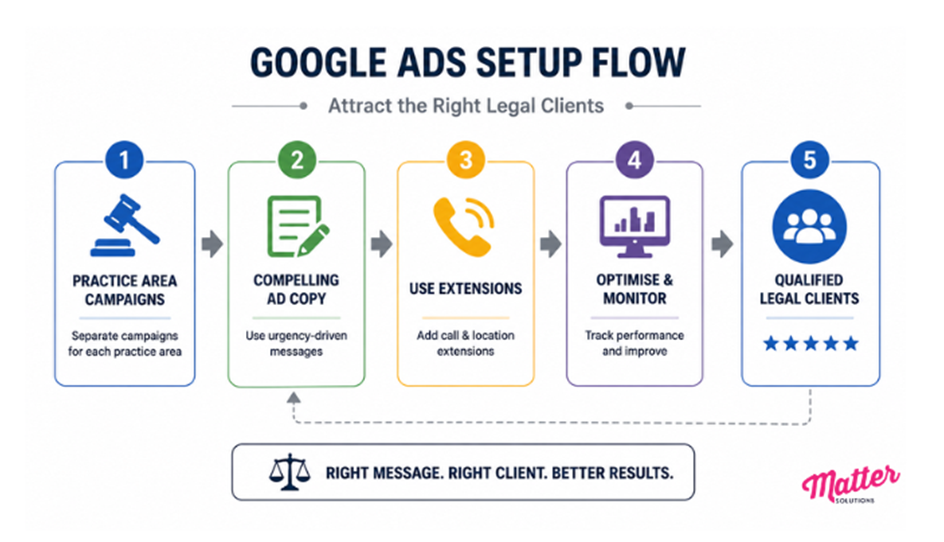
Here’s how that breaks down:
Separate Campaigns by Practice Area
Each practice area your firm handles should sit in its own campaign or ad group. Family law, personal injury, and commercial litigation attract different potential clients. And if you group them together, your ad copy will stay generic, and your Google Quality Score will drop.
Why Urgency Wins in Ad Copy
Strong ad copy connects with people who need legal services now. Phrases like “speak to a lawyer today” or “free consultation available” perform well because they match the urgency someone feels when actively searching for legal help in their area.
Extensions That Drive Direct Contact
Call extensions and location details give searchers a direct line to your firm from the search results page. If you skip these, you will lose potential clients who want a fast response without browsing through your law firm’s website first.
Landing Pages That Turn Clicks Into Legal Clients
Most legal ad clicks lead to a page that asks the visitor to do too many things at once, and that kills conversions. If someone clicks your ad and lands on a cluttered page, they’ll likely hit the back button before they even read your firm’s name.
A strong landing page focuses on one goal: getting the prospective client to enquire. That means a single call to action, a short contact form above the fold, and a headline that matches the ad they clicked.
Plus, trust signals like client testimonials, years of experience, and accreditation logos all reduce that initial hesitation (that split-second doubt costs more than most firms realise). From our experience building landing pages for law firms, even a small change like moving the form higher on the page can lift enquiry rates noticeably.
Speed counts here, too. If a landing page takes more than a few seconds to load on mobile, most website visitors will leave before they see your offer.
How to Control Ad Spend and Still Get Quality Leads
Truth be told, you don’t need a huge budget to generate consistent leads from Google Ads. You just need tighter control over where every dollar goes.
Bottom line? Google will spend whatever you let it, so these three controls keep your campaigns on track.
| Tactic | What It Does | When to Use It |
| Daily Budgets and Bid Caps | Limits how much your firm spends per day and per click, keeping you competitive in high competition legal auctions | From day one of any campaign |
| Search Term Reports | Shows which searches bring in quality leads and which ones waste your budget | Review weekly |
| Dayparting | Restricts your ads to business hours when your team can answer calls and respond to enquiries | Best for firms with limited staff |
If you review search term reports each week, you will spot wasted spend early and redirect that budget toward campaigns bringing in high-quality leads. And since legal advertising costs run high, many firms leave these settings untouched for months. That’s where the real waste builds up.
From there, the real question is whether those leads are turning into paying clients.
How to Track Legal Advertising Results Across Your Marketing Efforts
You’ve got the budget under control, now it’s time to figure out which ads are doing the heavy lifting. Without proper tracking, every marketing decision becomes a guess. So, here’s what to put in place:
- Call and Form Tracking: Call tracking and form tracking show you exactly which ads and keywords generate real enquiries for your firm. Without this data, you only see clicks, not the actual client inquiries that lead to new business.
- CRM Integration: One thing that comes up in almost every PPC account we manage is the gap between what looks like a good lead and what becomes a signed client. Connecting Google Ads to a CRM closes that gap by showing whether your marketing efforts produce real business or just initial contact.
- Monthly Cost Reporting: Tools like Google Analytics and your ads dashboard give your firm a clear view of cost per lead and cost per client each month. This data makes your advertising a measurable and accountable part of your law firm marketing strategy, rather than just another expense.
Pro Tip: Start with call and form tracking, connect it to your CRM, and use the monthly data to refine where your budget goes.
Social Media vs Search Engine Ads: Where Should Law Firms Spend?
Search engine ads outperform social media for law firms when the goal is generating enquiries, instead of building followers. Both channels play a role in digital marketing, but they serve very different purposes.
| Factor | Social Media Ads | Search Engine Ads |
| Intent Level | Low, users browse passively | High, users actively search for lawyers |
| Lead Quality | Brand awareness leads | Direct enquiry-ready leads |
| Best Use | Long-term visibility and trust | Immediate lead generation |
| Cost Efficiency | Lower cost per impression | Higher cost per click but stronger conversion rates |
Social media builds brand awareness over time, but it rarely captures people who need a lawyer right now (search ads typically convert 3–5x higher than social campaigns). Most law firms see the best results when social media supports brand trust and search ads drive the actual enquiries for their business.
Getting More Quality Leads Starts With Smarter Google Ads
Every section above points to the same idea. Smarter structure behind your Google Ads campaigns means more enquiries, and the details covered in this guide, like ad copy, landing pages, and tracking, are what hold that structure together.
If your law firm is running ads without a clear strategy, the results will keep falling short. And ultimately, getting each part of your campaign working together is what will bring a steady flow of new clients. At Matter Solutions, we’ve helped law firms and lawyers across Australia build Google Ads campaigns that bring in quality leads month after month. If you’re ready to get more from your marketing, get in touch with our team today
